Reset
One food focus a day: hydration, fiber, probiotics, anti-inflammatory foods, gentle support, nutrients your gut lining uses, then diverse fibers. Each comes with planned meals, and your quiz answers shape which recipes come first.
Your daily gut health companion. Open 7DGR for a suggested next step, meals that fit where you are, and a place to record how you feel. Over time, those check-ins become a history you can use to make your next choice or bring to your doctor.
Answer a short quiz and see your Day 1 before you pay.
$9.99 a month or $69 a year, on Google Play.
Food and habits, not medical care.
The fridge-door moment
You’ve had yogurt for breakfast all week. This morning, you feel bloated. You slept badly, too. Now you’re standing at the fridge wondering whether to cross off another food you like.
We call that tangle Digestive Confusion. Food, sleep, stress, and symptoms can all change in the same week. When you feel better or worse, it’s hard to know what’s worth changing and what’s worth keeping.
What researchers found
Researchers keep finding the same tangle. In daily diary studies of women with IBS, a worse night’s sleep was followed by more gut symptoms or pain the next day. In a survey of 156 healthy women, 73% had at least one gut symptom in the days before or during their period. And in national surveys of US adults, people who saw more mixed nutrition messages were more confused about what to eat.
Sources: Jarrett 2000, Buchanan 2014, Bernstein 2014, Nagler 2014, Lee, Nagler and Wang 2018 and Suarez 1995
Food usually takes the blame first. In a blinded trial, 30 adults who called themselves severely lactose intolerant drank a cup of milk with breakfast every day for two weeks, one week regular and one week lactose-reduced, without knowing which was which. Symptom ratings stayed minimal and about the same both weeks, even though 21 of them tested as not fully digesting lactose. The researchers concluded that people may blame lactose for symptoms it didn't cause.
The old way
The new way
The Reset-Balance Method
The Reset-Balance Method brings widely recommended food and lifestyle practices into a daily routine. The Reset side gives you practical ways to support your gut through food and hydration. The Balance side helps you build habits around sleep, movement, and winding down.
The guided 7-Day Gut Reset gives you a place to begin.
Today puts your next step up front. Reset shows where you are and walks you through the day’s pair.
Meals helps you choose recipes that fit your preferences and your stage. When you want to know why a practice is in the plan, the Library is there to explore.
Days 1 to 6 each add one food step and one new practice. Day 7 is for choosing what to keep. Your meals are planned for every day of the week.
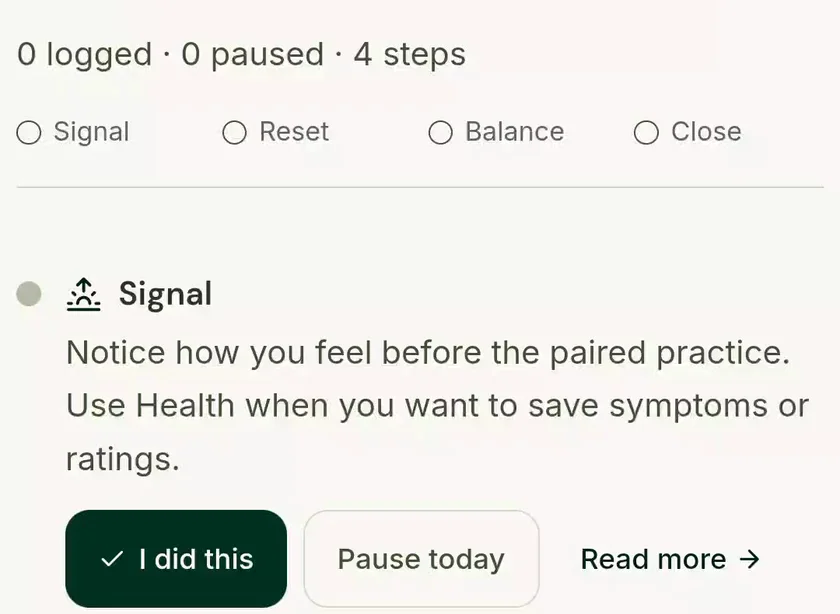
Every day runs the same four steps.
Signal. Notice how you feel before you start.
One food focus a day: hydration, fiber, probiotics, anti-inflammatory foods, gentle support, nutrients your gut lining uses, then diverse fibers. Each comes with planned meals, and your quiz answers shape which recipes come first.
One practice a day: sleep and circadian alignment, mindful eating, paced breathing, time in nature, laughter and connection, gentle rhythmic exercise, then locking in your routine.
Close. An evening reflection on what you noticed today.
If you miss a step, tap Pause today, and that step never shows as incomplete.
Reset with Hydration Water when you wake up
Balance with Sleep & Circadian Alignment Dimmer lights before bed
Close Evening check-in
Reset with Fiber A fiber food you tolerate, added to meals
Balance with Mindful Eating Sit down, take three breaths, and eat one meal slowly
Close Evening check-in
Reset with Probiotics A small taste of a fermented food if ferments agree with you, or oats, apple or cooled rice instead
Balance with Paced Breathing Paced breathing with the guided timer
Close Evening check-in
Reset with Anti-Inflammatory Foods One meal built around oily fish, greens, berries or turmeric
Balance with Nature Exposure Time near trees, grass, soil or water
Close Evening check-in
Reset with Gentle Support One plant food you tolerate, such as bitter greens, beets or citrus
Balance with Laughter & Social Connection A laughter break or a call with someone supportive
Close A check-in on energy, mood and how the day felt
Reset with Nutrients Your Gut Lining Uses One meal with broth, cabbage, pumpkin seeds, oily fish or another protein you tolerate
Balance with Gentle Rhythmic Exercise An easy walk after one meal, if it feels good
Close A check-in on energy, mood and how meals sat
Reset with Diverse Fibers A mix of fiber foods you tolerate
Balance with Routine Lock-In Choose your Keystone 3 anchors: one for the morning, one around a meal, one for the evening
Close Your final check-in, and a note on what you'll keep
Real screens from 7DGR.
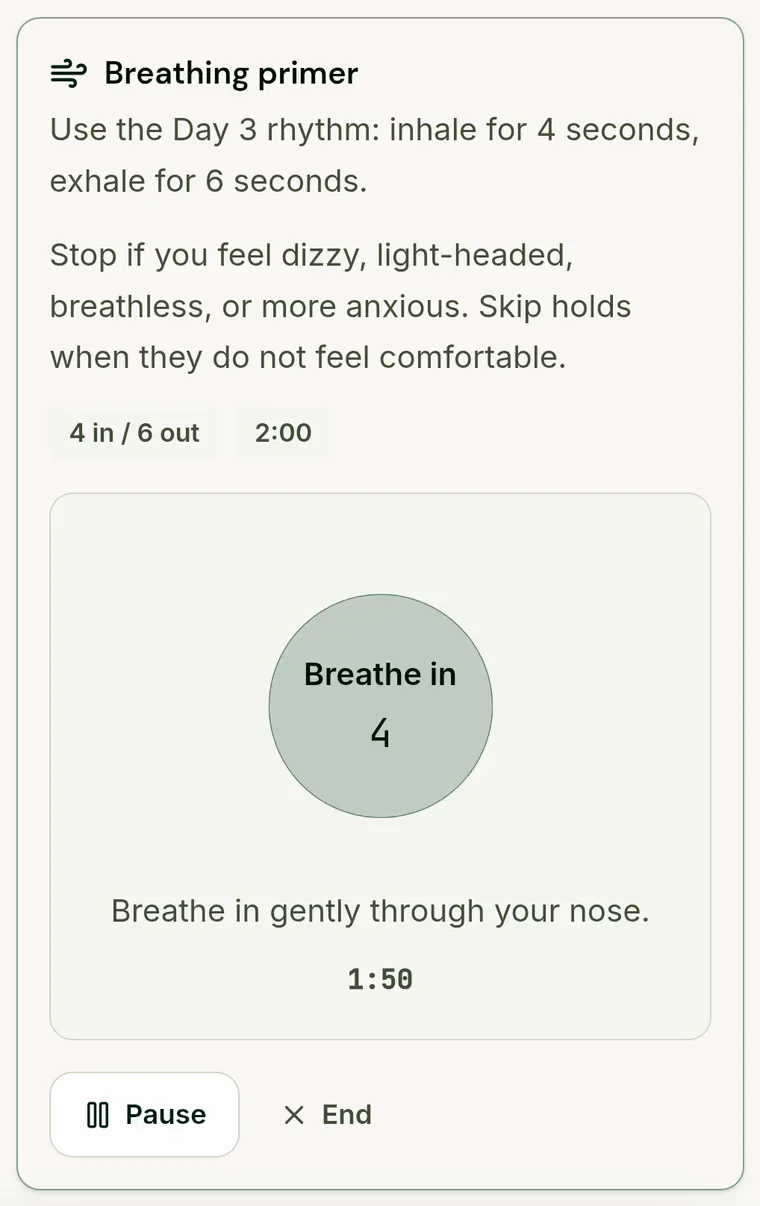
Tap start and follow the count. You breathe in for 4 seconds and out for 6, with no holds, and the session runs two minutes.
After the reset, you have more room to choose what you cook and which practices you carry forward. That matters, because new habits take time. In a 2024 review of 20 studies, the ones that timed it found a median of about two months for a health habit to feel automatic.
After Day 7, the Reset tab names one next step each day from your saved records, such as a practice, a food test to continue, or a record to review.
A short morning check-in and an end-of-day wrap-up, with reminder times you set. Each one adds a day to your Health history.
When you want to look back, you can see what you recorded about meals, symptoms, and sleep together. That makes it easier to remember what was happening on the days you felt better and the days you felt off.
The Clue Log follows one change for up to 7 days while you keep everything else familiar. Each day gets a short note: rougher, same or steadier. Changing one thing at a time is the plain answer to Digestive Confusion.
If you’re still wondering about yogurt, you can record what you tried, how much you ate, and what you noticed afterward. If the picture is mixed, 7DGR can suggest waiting or observing again. You have a next step before you decide what to take off the menu.
On Day 7 you choose one anchor for the morning, one around a meal and one for the evening, and you can change the cues later. In the same 2024 review, habits people chose for themselves, and morning habits, tended to be stronger.
Search the same 88 recipes after the week ends. Recipes with a food you avoid show a swap or move down your list.
Note the plants you eat across the last 7 days, with no daily target.
Create a visit summary PDF from the records you’ve already kept. Choose a date range, preview the summary, and bring it to your doctor.
When you want a fresh week, start another 7-day reset. Your health logs, food test records and recipes stay, so your history keeps growing.
Visit summary PDF
“How often has this been happening?” is a hard question to answer from the exam table.
Create a visit summary PDF from the records you’ve already kept. Choose a date range, preview the summary, and bring it to your doctor. You can sit down with a record of what you noticed, what you tried, and the questions you want to ask.
Memory drifts, even over one week. In a study of 273 adults with IBS who rated their gut symptoms every evening for 7 days, recall on day 8 lined up for some symptoms, such as worst pain, and drifted for others, such as typical pain.
Self-reported, and not a diagnosis. Source: Lackner 2014
Fixed rules run your plan. Nothing learns from your data or guesses for you.
The NIH’s digestive disease institute lists more fiber, more physical activity, fewer stressful situations and enough sleep among the lifestyle changes worth trying. The UK’s NICE adds regular meals you take time to eat, and time set aside to relax. The daily Reset and Balance steps put these basics into a routine. Sources: NIDDK and NICE CG61, both written for adults with IBS.
The American Gastroenterological Association describes food plans that end with bringing foods back and personalizing from the results. Monash University’s FODMAP team says to reintroduce one at a time “so you get clear results.” 7DGR’s Food testing follows the same rule, and a new test can’t start until the last one is closed.
The same AGA guidance asks patients to bring dietary information to a dietitian visit, and the NIH notes your doctor may ask for a diary of foods, drinks and when symptoms happen. 7DGR builds that record from the check-ins you already do.
Your quiz answers set the recipe order. Foods you avoid, from 17 avoid tags, get a swap or move down your list. After Day 7, your recent check-ins move the suggested practice, for example toward paced breathing after a high-stress day.
No list of foods to cut for good, and no promise about how your gut will respond.
7DGR is a food and habit planner. It is not medical care. If symptoms are severe, keep coming back or worry you, see a clinician.
Six videos
Received 7DGR free.
Received 7DGR free.
Received 7DGR free.
Received 7DGR free.
Received 7DGR free.
Received 7DGR free.
No free trial. You pay through Google Play, and your plan renews until you cancel in Google Play.
$9.99 a month or $69 a year, on Google Play.
Food and habits, not medical care.
Common questions about the week, your records, your doctor and billing.
Food testing opens, one food at a time. The Reset tab suggests one step each day from your saved records. Your check-ins, Health history and recipes stay in the app, and you keep the three anchors you chose on Day 7, which you can change later. When you want a fresh week, start another reset and your history stays.
Choose food-fit needs such as low-FODMAP, dairy-free, nut-free or plant-based soy-free, and mark the foods you avoid from 17 avoid tags. These change how the 88 recipes rank, and a recipe with a food you avoid shows a swap or moves down your list. They don't promise any food in your plan. If you have a food allergy, read each recipe's ingredients.
The 7 days don't ask you to cut a food. Each daily food step adds something to a meal. Food testing, after Day 7, looks at one food at a time, and you choose which one. Mark the foods you avoid, and the recipe list works around them.
Yes. 7DGR is a routine and a record, and it works alongside your care. Make a visit summary PDF of the last 7, 30 or 90 days, preview it, and bring it to your appointment. It lists what you recorded and the questions you saved. It is self-reported, and it is not a diagnosis.
7DGR is on Google Play for Android phones. You buy and manage your plan through Google Play.
No. Tap Pause today on any step, and that step never shows as incomplete.
Each day has one food step, one practice and a short reflection. The Day 3 breathing timer runs two minutes.
No. Fixed rules build your plan. Your quiz answers set the recipe order, and the foods you avoid, your food-fit needs and your preferences change how recipes rank. After Day 7, your recent check-ins change which practice the app suggests. Nothing learns from your data.
$9.99 a month or $69 a year, on Google Play. There is no free trial.
Open the Google Play Store app, tap your profile icon, then Payments and subscriptions, then Subscriptions. Pick 7-Day Gut Reset and tap Cancel subscription. Deleting the app does not cancel your plan. Google's steps: https://support.google.com/googleplay/answer/7018481
Google Play handles billing and refund requests for subscriptions bought on Google Play. Google's refund policy: https://support.google.com/googleplay/answer/2479637
No. 7DGR is a food and habit planner. It does not diagnose or treat any condition. For medical questions, talk to a healthcare professional.
Ask your clinician before you change how you eat or start a food test if you have a digestive condition, take medication, are pregnant, or have a history of disordered eating.

7DGR (7-Day Gut Reset) is a food and habit planner from Mount Nurture LLC. It is general education and is not medical care. It doesn’t replace advice from a clinician. The studies linked on this page describe groups of people. Most are small or observational, several studied adults with IBS, and none tested 7DGR. Google Play handles all purchases.